KITCHEN REMODEL BUDGET GUIDE · GRAND RAPIDS MI · UPDATED OCTOBER 14, 2026
Kitchen Remodel Hidden Costs in Grand Rapids MI: 10 Surprises to Budget For (2026)
The costs that rarely appear in a first estimate, from old wiring and subfloors to lead testing, permit fees and change orders, and how much cushion a Grand Rapids kitchen actually needs.
✍️ Written by a licensed Michigan kitchen remodeling contractor · 119 Paddock Ave SE, Grand Rapids, MI 49506 · (866) 624-1696 · EPA RRP-Certified · $2M Insured
Nobody plans for a surprise. But in a Grand Rapids kitchen, especially one in an older house, a few of them show up on almost every job: a floor that is not level, wiring that is not to today’s code, a layout change that costs more than the sketch suggested.
This guide lists the ten that come up most often, what they typically cost on our Grand Rapids planning ranges, and how to leave room for them. For the base price of each scope, see our kitchen remodeling cost guide. All numbers here are planning ranges, not quotes.
IN THIS GUIDE
QUICK ANSWER — Grand Rapids Kitchen Remodel Hidden Costs
The cheapest way to handle a surprise is to plan for it before demolition starts.
THE BASICS
What Are Hidden Costs in a Kitchen Remodel?
Hidden costs are the expenses that were real from day one but were not on the first estimate, either because nobody could see them yet or because nobody priced them. Some are unavoidable. Many are just unpriced.
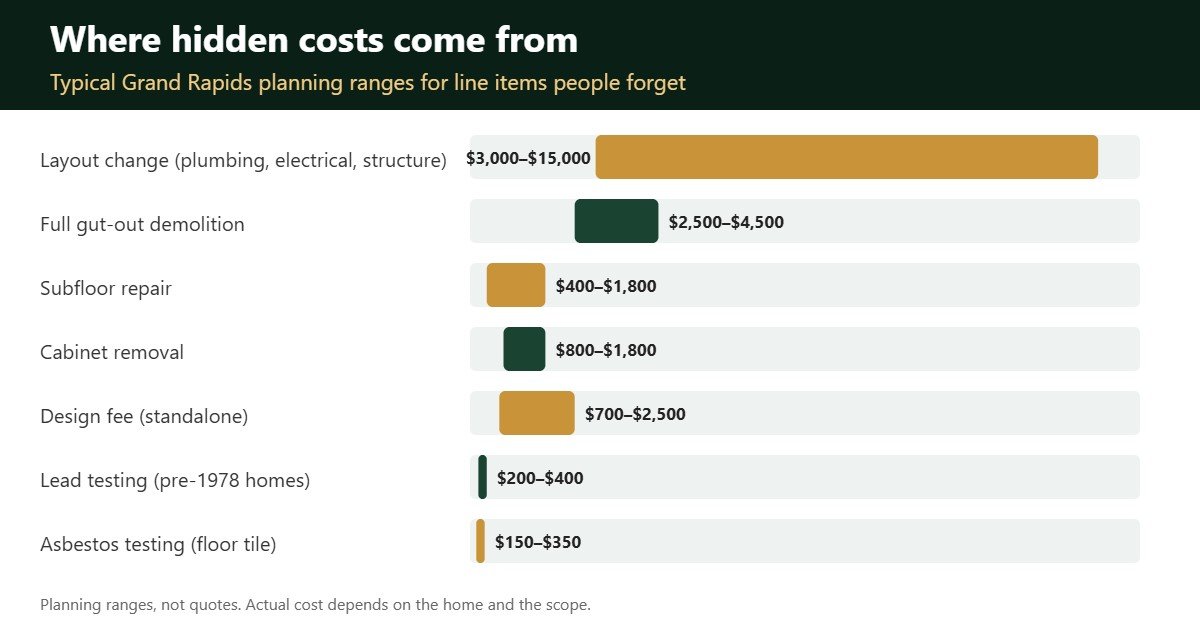
| # | Surprise | Typical Grand Rapids range | Where it shows up |
|---|---|---|---|
| 1 | Wiring or plumbing found behind the walls | Covered by contingency (not predictable before demo) | Older homes |
| 2 | Subfloor repair | $400–$1,800 | Uneven floors, moisture damage |
| 3 | Lead testing | $200–$400 | Homes built before 1978 |
| 4 | Asbestos testing (suspect floor tile) | $150–$350 | Older vinyl and floor tile |
| 5 | Permits and inspections | Set by the city; see the fee examples below | Plumbing, electrical, wall changes |
| 6 | Layout change | $3,000–$15,000 | Moving a sink, doorway or wall |
| 7 | Full gut-out and cabinet removal | $2,500–$4,500 gut-out; $800–$1,800 cabinet removal | Larger remodels |
| 8 | Appliance installation | $1,800–$3,500 basic; $3,500–$8,500 full suite | Gas, venting, water lines |
| 9 | Design fees (if not included) | $700–$2,500 standalone | Design-only work |
| 10 | Change orders and upgrades | Depends on the change | Mid-project decisions |
Two kinds of surprise
Some are discovered (rot, old wiring, lead paint). Others are chosen (upgrades, layout changes, new appliances). You can plan for the first with contingency and prevent the second with a clear scope before work starts.
OLDER HOMES
Surprises Inside the Walls of Older Grand Rapids Homes
Census-based estimates for 2019–2023 put roughly 54% of Kent County homes as built in 1979 or earlier. That means a lot of kitchens sit on old wiring, old supply lines and floors that have settled over decades.
On pre-1978 homes, our planning notes call out galvanized supply lines, subfloor rot, knob-and-tube wiring, lead paint and asbestos floor tile as the usual finds. Structural surprises are not predictable before demolition, which is the whole reason a contingency line exists.
How much can subfloor problems add?
Subfloor repair runs about $400–$1,800 in our ranges. It is a small line next to cabinets, but it rarely makes it into a first guess, and it has to be fixed before new flooring goes down. Our flooring page covers what we install on top.
Does the age of my neighborhood matter?
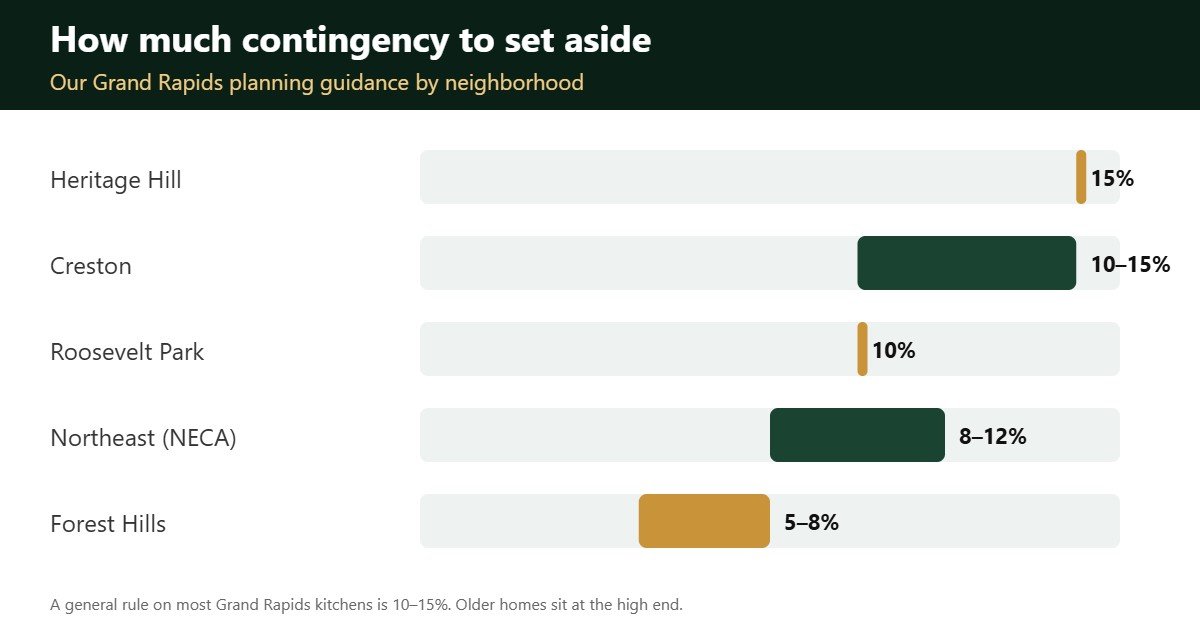
Yes. We plan a full 15% contingency for Heritage Hill, 10–15% for Creston, 10% for Roosevelt Park and 8–12% for Northeast Grand Rapids. See the neighborhood pages for Heritage Hill, Creston, Roosevelt Park and NECA.
TESTING
Lead and Asbestos Testing in Older Grand Rapids Homes
If your house was built before 1978, expect a lead check before work that disturbs painted surfaces. The EPA’s Renovation, Repair and Painting (RRP) rule sets the lead-safe work requirements for paid renovation in older homes. In our ranges, lead testing runs about $200–$400.
Floor tile and sheet vinyl from certain decades can contain asbestos, so a test on suspect flooring runs about $150–$350 in our ranges. The test is the cheap part. If the result is positive, it changes how the floor is removed and what that costs, which is why we test before demolition, not during it.
What to ask
Ask whether testing is in your quote or billed separately, and what the plan is if a test comes back positive. A good contractor can answer both before you sign.
PERMITS
Permit, Inspection and Delay Costs
Permits are small next to cabinets, but they are real money and real time. The City of Grand Rapids publishes its fees in the FY2027 planning, design and development fee schedule, effective July 1, 2026. A few examples from it:
- Building permit: $54 base plus $6.80 per $1,000 of construction cost, plus a $25 zoning permit for one- and two-family homes. The city’s own sample shows $419 for a $50,001–$51,000 project.
- Electrical and plumbing permits: each starts at $52 and includes one inspection. An additional inspection is $42.
- Starting before the permit: an administrative fee of $173 applies for work done before a permit.
- Not ready for inspection: $84 when the work is not ready, or when the inspector cannot get access.
The City says homeowners can do work themselves with the proper permits, and when you hire a contractor, the contractor normally applies. Either way, ask whether permit fees are in your quote or billed separately. Online plan review is in most cases within three business days, according to the city.
How do delays turn into costs?
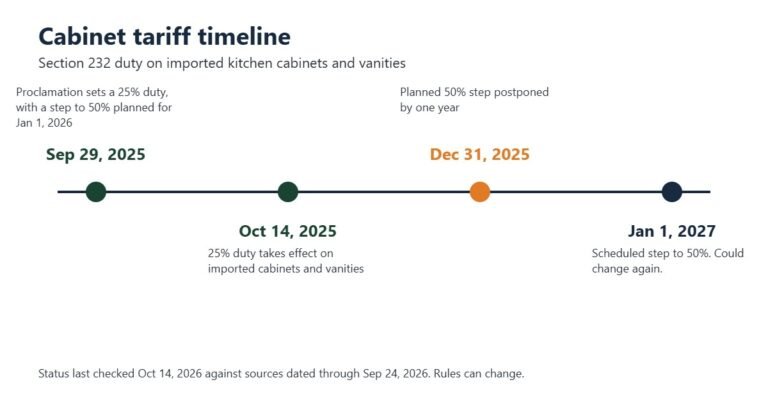
A failed or missed inspection, a late cabinet delivery or a surprise behind the wall all push the schedule. Time costs money in a lived-in house: more weeks of eating out or washing dishes in a bathroom sink. Imported cabinets also carry a 25% tariff right now, which we cover in our cabinet tariffs and lead times guide. See the remodel timeline guide for where each step falls.
CHANGE ORDERS
Change Orders and Upgrades: The Surprises You Choose
A change order is a written change to the agreed scope, with its price. They are normal, and they are also where budgets quietly grow. The most common ones we see:
- Moving something. A sink, a doorway or a wall. Layout changes run about $3,000–$15,000 in our ranges, and our layout guide explains why.
- Switching materials. Quartz to granite or the reverse, as covered in our quartz vs granite guide.
- Upgrading cabinets. Stock cabinets run about $3,000–$8,000 plus $2,000–$4,000 for installation, semi-custom $8,000–$22,000, and custom $22,000–$45,000.
- Adding appliances late. Basic installation runs $1,800–$3,500 and a full suite $3,500–$8,500, depending on gas, venting and water lines. See our appliance services page.
The fix is simple: decide the cabinets, counters, appliances and layout before work starts, and ask that every change be priced in writing before it is built.
CONTINGENCY
How Much Contingency Should You Set Aside?
Our rule is to always budget 10–15% for contingency. For a $40,000 project, that is $4,000 to $6,000. If nothing goes wrong, you keep it. If something does, you are not scrambling for a second loan.
What is the biggest expense in a kitchen remodel?
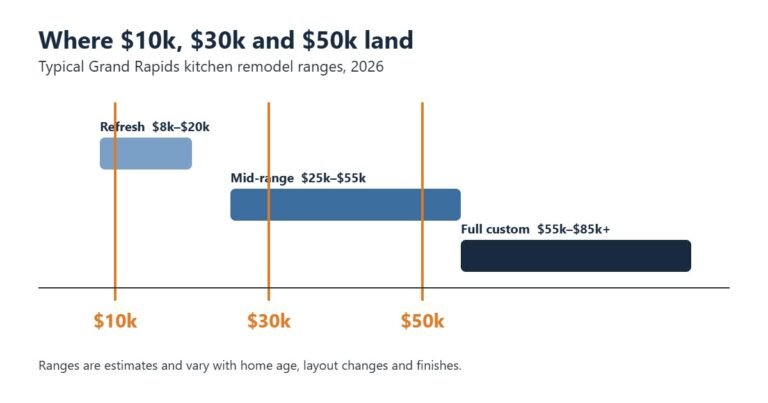
Cabinets, usually. Stock cabinets run $3,000–$8,000 plus installation, semi-custom $8,000–$22,000, and custom $22,000–$45,000. Counters are typically 15–25% of the total. See the $10k, $30k and $50k breakdown for how those pieces add up at each budget.
Should contingency be in the same pot as upgrades?
No. Keep it separate, and treat it as spent only on surprises. If you are borrowing, read our financing guide so the loan amount covers the cushion, not just the base price.
PLAN AHEAD
How to Protect Your Budget From Hidden Costs
- Get an itemized, written quote so you can see every line, not one total.
- Ask what is not included: permits, testing, disposal, appliance install, paint.
- Settle layout, cabinets and counters before demolition.
- Keep a contingency of 10–15%, and more for a house built before 1978.
- Ask how change orders are priced and approved before you sign.
- Compare quotes line by line. Our guide on choosing a contractor covers what to ask.
Working with a small footprint or tight budget? Our small kitchen renovation guide shows where money goes furthest, and our demolition page explains what a gut-out involves. We serve Kentwood, Wyoming, Grandville and the rest of Kent County.
QUICK ANSWERS — HIDDEN COSTS FAQ
People Also Ask — Kitchen Remodel Hidden Costs in Grand Rapids MI
Click any question to expand the answer.
Where these numbers come from: cost ranges and contingency percentages are our Grand Rapids planning figures for 2026 and are not quotes. Permit fees come from the City of Grand Rapids FY2027 fee schedule (effective July 1, 2026). Lead-safe requirements come from the EPA RRP program. Housing-age figures are Census-based estimates for 2019–2023. Last reviewed October 14, 2026.
WRITTEN BY
Kitchen Remodeling Grand Rapids MI
Licensed Michigan design-build kitchen remodeling contractor. EPA RRP-certified. $2M general liability. Serving Heritage Hill to Kent County since 2009. Cost ranges in this guide are our own Grand Rapids planning figures; outside sources are linked where used.
Michigan Builder License · EPA RRP-Certified · $2M Insured · 4.9★ Rating
Ready For Your Free Grand Rapids Kitchen Estimate?
We come to your home, measure your kitchen, assess existing conditions and deliver a fixed-price written proposal within 5–7 business days. No vague ranges. No pressure calls the next day.
119 Paddock Ave SE · Grand Rapids, MI 49506 · Serving all of Kent County