COUNTERTOP GUIDE · GRAND RAPIDS MI · UPDATED OCTOBER 14, 2026
Quartz vs Granite Countertops in Grand Rapids MI: Cost, Durability and Downsides (2026)
A straight comparison from a local kitchen remodeler: what each stone costs, how it behaves in a working kitchen, where quartz falls short, and which countertops are the most durable and the most affordable.
✍️ Written by a licensed Michigan kitchen remodeling contractor · 119 Paddock Ave SE, Grand Rapids, MI 49506 · (866) 624-1696 · EPA RRP-Certified · $2M Insured
Countertops are one of the first choices people make in a remodel and one of the hardest to undo. Quartz and granite are the two names that come up in almost every Grand Rapids kitchen conversation, and the internet is full of strong opinions about both.
This guide sticks to what can be checked: our own Grand Rapids planning prices, what the slab makers say about care, and a few outside sources that are linked where we use them. Our countertops page covers every material we install, and the kitchen remodeling cost guide shows where counters fit in the whole budget. Treat every number as a planning range, not a quote.
IN THIS GUIDE
QUICK ANSWER — Quartz vs Granite
Quartz costs more on average, but the gap narrows at the premium end. Always price the specific slab.
AT A GLANCE
Quartz vs Granite Countertops: What Is the Real Difference?
Granite is a natural stone that is quarried, cut and polished. Quartz countertops are engineered: ground quartz mixed with polymer resin and pressed into slabs. That difference drives almost everything else, from sealing to pattern to price.
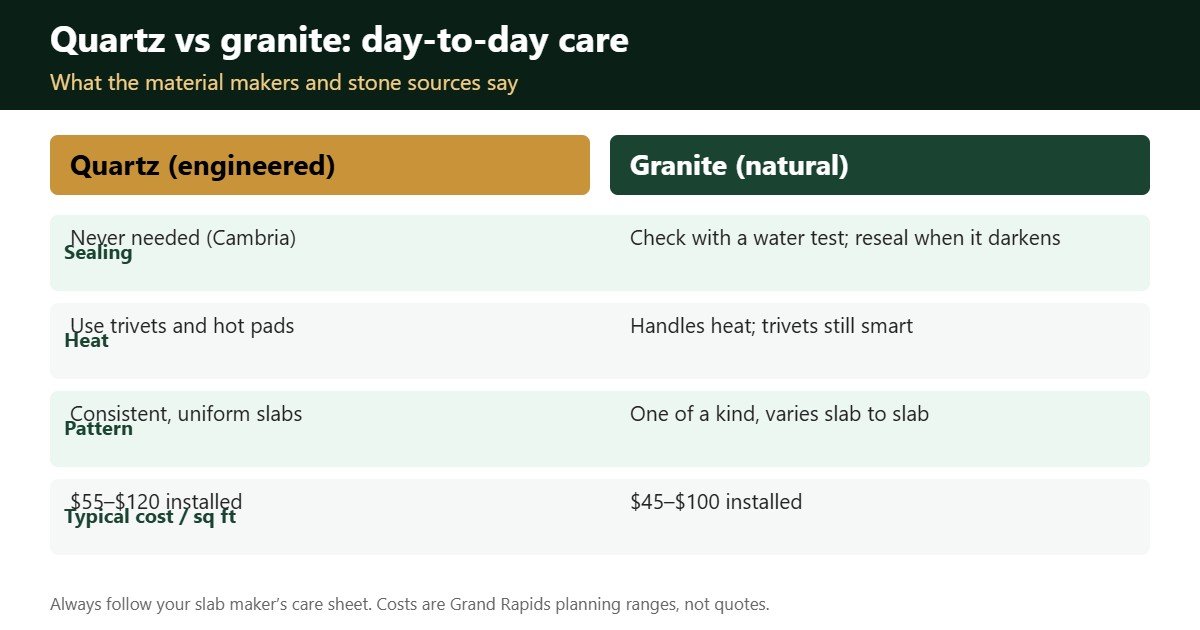
| Quartz | Granite | |
|---|---|---|
| What it is | Engineered stone made in a factory from ground quartz and resin | Natural stone cut from a quarry |
| Installed cost | About $55–$120 per sq ft | About $45–$100 per sq ft |
| Sealing | Not needed. Cambria says its quartz never needs sealing | Needed from time to time. Check with a water test |
| Heat | Use a trivet. Cambria says its surface is not heat-proof | Handles high heat well; a trivet is still smart |
| Look | Consistent color and pattern from slab to slab | Unique veining and color; no two slabs match |
| Seams | Visible on longer runs, per our experience and our countertop page | Placed to follow the natural veining; ask where they will fall |
| Weight | Heavy; cabinets must be solid | About 18–20 lbs per sq ft at 3 cm, so cabinet support matters |
Is granite cheaper than quartz?
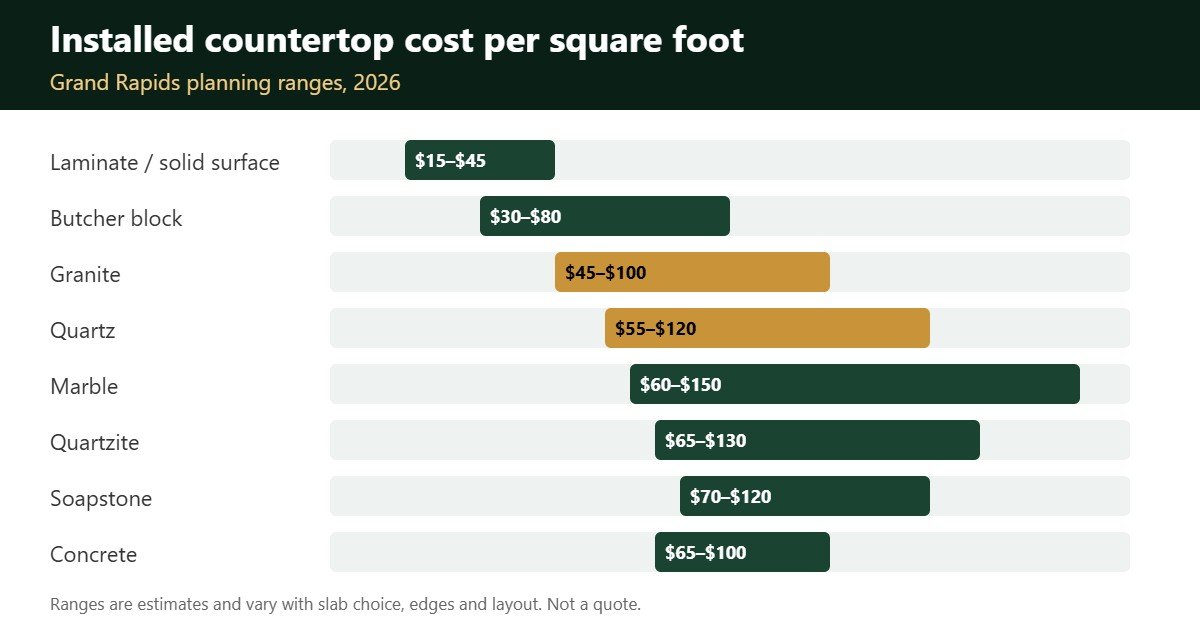
Usually, yes. On our Grand Rapids ranges granite runs about $45–$100 per square foot installed and quartz about $55–$120. A July 2026 industry cost guide puts national installed averages at $40–$100 for granite and $50–$120 for quartz, and says quartz costs more mainly because of manufacturing overhead and brand premiums. It also notes the gap narrows or flips at the premium end, where exotic granites can cost more than premium quartz. So price the actual slab, not the category.
Install timing
Countertop templating happens after the cabinets are set, which is why a late cabinet delivery delays your counters too. On our jobs, fabrication takes about 5–10 business days and installation about a day, roughly two weeks from template to finished counters. See the remodel timeline guide for where this fits.
QUARTZ DOWNSIDES
What Are the Downsides of Quartz Countertops?
Quartz is a good product, and plenty of kitchens do well with it. These are the real trade-offs to weigh before you pay for it.
What is the downside of quartz countertops?
- Heat. Cambria recommends a closed-weave hot pad or solid trivet under pots, pans, air fryers, slow cookers and roasters, and says sudden temperature changes near edges or prolonged heat can damage the surface. Our countertop page also warns that hot pans can crack quartz.
- Price. It averages higher than granite, and brand premiums add to it.
- Not for outdoor kitchens. UV and temperature cycling are a poor match, which matters in a city with long freezing winters.
- Visible seams. Longer runs will show a seam line, and uniform patterns can make it more obvious.
- Harsh cleaners. Cambria says to avoid bleach, oven cleaners and abrasive pads.
Why is quartz on the decline?
We could not find a reliable national sales figure showing a decline, so we would be cautious about headlines that say so. What we can say is what homeowners tell us they weigh: natural-stone looks, heat concerns, and the fabrication-health stories below. If you see a claim about market share, ask where the number comes from.
Is the silicosis issue a risk for homeowners?
The documented risk is to the people who cut and finish the stone. The CDC reported 18 silicosis cases, including two deaths, among engineered-stone countertop workers in four states, and said engineered stone can contain much more crystalline silica (over 90%) than granite (under 45%). The same page says it does not address risk to homeowners, so we will not claim one. If you are hiring a fabricator, it is fair to ask how they control dust when they cut. Details: CDC NIOSH Science Bulletin.
GRANITE
Granite Countertops: Pros, Cons and Sealing
Granite is natural, so every slab looks different. That is its main appeal and, for some people, its main frustration. You pick the actual slab, not a sample.
What are the pros of granite?
- Handles heat better than quartz and other engineered surfaces, per our countertop page.
- A one-of-a-kind look, with value that holds up at resale.
- Often the lower price of the two on a standard installation.
What are the cons of granite?
- It is porous, so it needs sealing from time to time or it can absorb moisture and stains.
- It is heavy: about 18–20 lbs per square foot at 3 cm, so weak or old cabinets need checking before install.
- Patterns vary, so a large island may not match a perimeter run from another slab.
Do granite countertops need to be sealed, and how often?
Yes, though how often depends on the stone and how you use it. Rather than trusting a calendar, run a water test: put a few drops of water on the counter and wait about 30 minutes. If the water soaks in and darkens the stone, reseal. Stone-care sources describe this same test, and some owners reseal every six months to a year. Ask your installer what sealer they used and when to retest.
Our rule of thumb
If you cook a lot, own cast iron, or set hot pans down without thinking, granite is the more forgiving choice. If you do not want to think about sealing at all, quartz fits better.
DURABILITY
What Is the Most Durable Countertop for a Busy Kitchen?
There is no single winner. Quartz, granite, quartzite and Dekton all handle daily use for years. The question is which weakness you can live with.
| Material | Strong at | Watch out for |
|---|---|---|
| Granite | Heat, a natural look, lower price | Needs periodic sealing |
| Quartz | No sealing, uniform color, stain resistance | Hot pans and sudden temperature change |
| Quartzite (natural) | Natural look at a higher price, about $65–$130 per sq ft on our ranges | Needs a trusted fabricator and slab choice |
| Dekton (sintered) | Cosentino says it handles high heat, resists scratches and stains, and tolerates sunlight | Premium price; ask for a slab-specific quote |
What is the lowest-maintenance countertop?
Quartz is the usual answer because it never needs sealing. Dekton is also non-porous per its maker. Granite is low-effort once it is sealed, but it is not zero-effort.
How do I care for quartz and granite day to day?
- Wipe with warm water, a soft cloth and mild soap.
- Use trivets and hot pads on quartz, and cutting boards on every surface.
- On granite, retest with water when the surface looks dull or stained.
- Skip abrasive pads and harsh chemicals unless your slab maker approves them.
BUDGET
What Are the Most Affordable Countertop Options?
Cheapest first, on our Grand Rapids ranges per square foot installed:
- Laminate or solid surface: about $15–$45. In the kitchen budget guide, laminate counters came to roughly $1,800–$3,500 for a typical kitchen.
- Butcher block: about $30–$80. Warm and affordable, but it needs oiling and attention to water.
- Granite: about $45–$100, and often the best-priced natural stone.
- Quartz: about $55–$120.
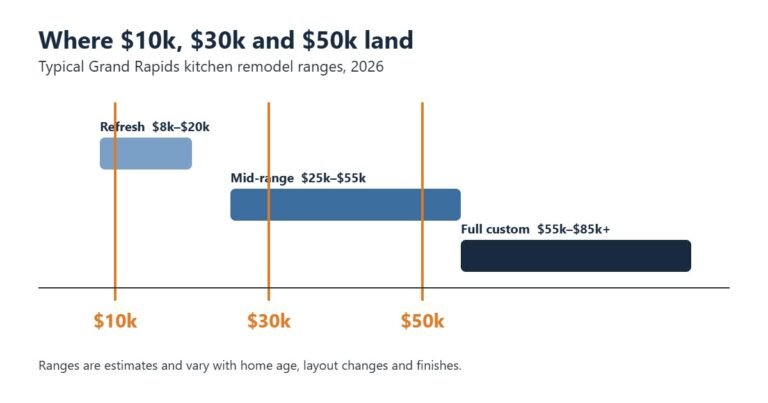
A 30-square-foot granite kitchen runs about $1,350–$3,000 on our ranges. Counters are usually 15–25% of a total remodel, so a lower-cost surface can free money for better cabinets. See the $10k, $30k and $50k breakdown for how counters fit into each budget, and our cabinets page for the other big line.
OTHER OPTIONS
Quartzite, Dekton and Marble Alternatives
What is quartzite, and how is it different from quartz?
Quartzite is a natural stone, while quartz is engineered. On our ranges quartzite runs about $65–$130 per square foot, and Calacatta-style quartzite is popular for a marble look without marble’s upkeep.
Is Dekton worth it?
Dekton is a sintered surface from Cosentino. The maker says it handles high heat, resists scratches and stains, and holds color in sun. Those are manufacturer claims, so ask your fabricator for the care sheet and a firm price. It makes the most sense for an outdoor kitchen or a very heavy-use space. Cosentino’s Dekton page lists the details.
What can I use instead of marble?
Marble runs about $60–$150 per square foot on our ranges and is softer, so acidic spills such as lemon juice or vinegar can dull it. If you love the look, consider Calacatta-style quartzite or a marble-pattern quartz. Both give you the veining with less upkeep. Soapstone ($70–$120) is another natural option with a matte look.
LOCAL TIPS
How to Choose Between Quartz and Granite in a Grand Rapids Kitchen
A few Grand Rapids realities are worth weighing:
- Older homes. In Heritage Hill and other pre-war houses, cabinets and floors may not be level, which is why templating happens after cabinets are set. See our Heritage Hill kitchen remodeling page.
- Seams and island size. Ask where seams will fall before you sign. Our layout guide shows how island and cabinet runs affect it.
- Weight. Granite at 3 cm is heavy; replacing cabinets in the same project, as in our cabinet lead-time guide, lets you plan support.
- Color and style. Current finishes are covered in our 2026 kitchen trends and cabinet color guides.
- See the slab. For natural stone, choose the actual slab in person, not a small sample.
We work across the city and Kent County, including Kentwood, Wyoming, Walker and Cascade. Not sure which fits? Our design team can compare slabs with you, and our guide on choosing a contractor covers what to ask.
QUICK ANSWERS — COUNTERTOP FAQ
People Also Ask — Quartz vs Granite Countertops in Grand Rapids MI
Click any question to expand the answer.
Where these numbers come from: cost ranges are our Grand Rapids planning figures for 2026 and are not quotes. National averages come from an industry cost guide updated July 2026. Quartz care guidance comes from Cambria. Silica and fabrication facts come from the CDC NIOSH Science Bulletin. Dekton claims come from Cosentino. Granite water-test guidance comes from stone-care sources. Last reviewed October 14, 2026.
WRITTEN BY
Kitchen Remodeling Grand Rapids MI
Licensed Michigan design-build kitchen remodeling contractor. EPA RRP-certified. $2M general liability. Serving Heritage Hill to Kent County since 2009. Price ranges are our own Grand Rapids planning figures; manufacturer and agency sources are linked where used.
Michigan Builder License · EPA RRP-Certified · $2M Insured · 4.9★ Rating
Ready For Your Free Grand Rapids Kitchen Estimate?
We come to your home, measure your kitchen, assess existing conditions and deliver a fixed-price written proposal within 5–7 business days. No vague ranges. No pressure calls the next day.
119 Paddock Ave SE · Grand Rapids, MI 49506 · Serving all of Kent County